
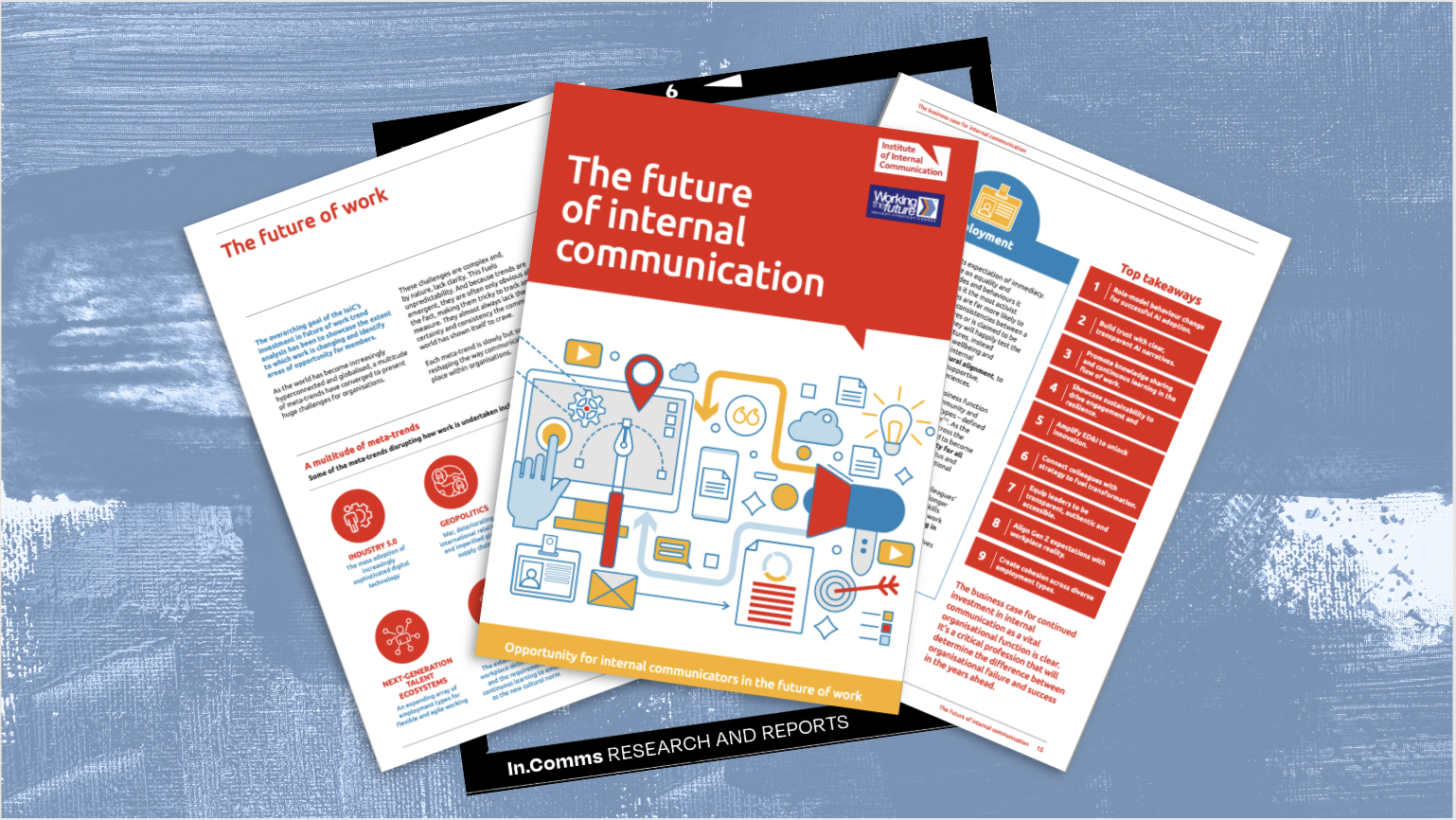
In order to thrive in business’s ever-shifting landscape, organisations need to change their working practices to be ‘more adaptable, aligned and human’, according to new research from the Institute of Internal Communication (IoIC).
Global instability, it argues, means trust is more vital than ever in what it describes as a “post-normal” business landscape, and internal comms teams have a unique opportunity to sit at the heart of their organisation and ensure people, strategy and action are aligned.
The IoIC’s ‘The Future of Internal Communication: Opportunity for Internal Communicators in the Future of Work’ white paper maps out how internal comms is evolving, and identifies numerous areas teams will need to tackle, including AI-enhanced communication; data-driven decision-making; adopting trust, truth and inclusion as first principles; and the alignment of people and purpose.
The report highlights numerous new opportunities for internal comms departments. These include cultivating strong workplace relationships which, it says, not only “enhance organisational resilience” but also alleviate loneliness; breaking down departmental silos to make sharing information more cohesive; and coaching leaders to become better communicators.
To support these new approaches and mollify feelings of uncertainty, the IoIC has identified several potential new internal comms roles, including a chief trust officer, head of business strategy, digital transformation manager, data analyst and head of culture. To succeed in these new roles, internal comms teams must upskill in critical areas such as business acumen, influencing, active listening, ethical communication and advocacy.
The paper also outlined a number of specific opportunities for internal comms teams to deliver value, emphasising that effective communication underpins all successful business transformation, including curating human connection, breaking down departmental silos, harnessing colleague voice and facilitating conversation to embed lasting behavior change.
“Organisations are operating in conditions of unprecedented complexity and uncertainty,” said Jennifer Sproul, chief executive of the IoIC.
“In this environment, performance depends on how effectively people can align, adapt and act together,” she added. “This white paper makes clear that internal communication is not a support function, it is a foundational capability that underpins action, transformation and long-term organisational success.”
Dominic Walters, president of the IoIC, added: “The goal of our white paper is to equip internal communication professionals with the knowledge they need to thrive in the future of work. Understanding the shifts transforming work will help internal communicators build more informed, connected and motivated workforces.”